

Beeston is a fantastic castle to visit, situated on a rocky escarpment, it’s twin towered gatehouse gives magnificent views of the Cheshire plains.

Visiting Beeston Castle
Beeston Castle is operated by English Heritage and as such is an easy site to visit. It is well sign posted, there is a decent car park and the usual gift shop/cafe/toilets that you’d expect. Beeston is set in quite large grounds so there is scope to spend half a day exploring the trails around the castle.
My Experience
Sadly, I didn’t have half a day for my visit to Beeston Castle. It was another work day my visit was squeezed in between appointments. I parked the car and then walked up to the castle entrance which was quite a trek in the midday August sunshine!
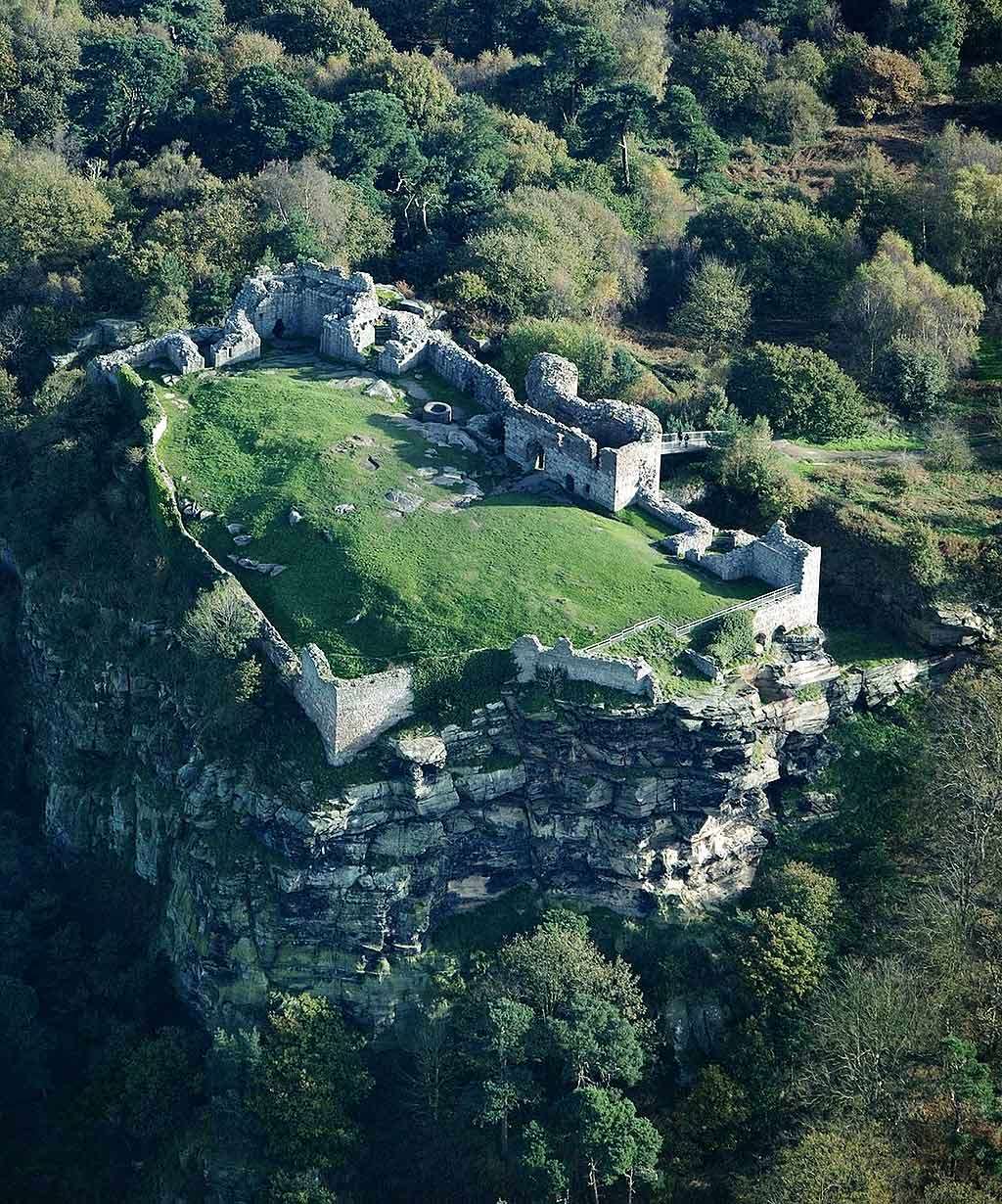
It’s not until you reach the top and look back through the gateway that you realise what a magnificent setting the castle is in. The phrase ‘commanding views’ barely does it justice, as the pictures hopefully show. The aerial picture below is copied from the English Heritage site to give a better idea of the tactical position of the castle.
Beeston Castle Photo Gallery


History
Occupied, at least periodically, during the Neolithic period (3500 to 2000 BC), the first known defences at the site of Beeston Castle were built in the Bronze Age (2000 to 650 BC) when an earth bank was created at the bottom of the crag to restrict access. This evolved over the subsequent centuries into a substantial hillfort by the end of the Iron Age (450 BC to AD 43) with parapets strengthened with stone rubble and topped by a timber palisade. Although the defences were probably never as elaborate as nearby Old Oswestry, it is possible that Beeston was one of the largest hillforts in Cheshire. It certainly seemed to be an important metal working site as the crag had significant mineral deposits whilst evidence of smelting has been discovered by archaeology. The site seemingly abandoned around the time of the Roman Invasion (AD 43) although the circumstances behind this are unknown; it is possible the populace was forcible relocated as at Maiden Castle in Dorset.
Beeston Castle itself was built circa-1220 by Ranulf, Earl of Chester. Built quite late compared to other fortresses along the Border Marches, it is likely it was constructed as a result of events in England rather than concerns over Welsh attack. In the latter days of King John’s reign, various Barons had rebelled and were supporting a French invasion, under Prince Louis. Ranulf had remained loyal to John throughout and after the rebellion lost steam following the death of John in 1216 and the defeat of the French at the Battle of Lincoln (1217), he was richly rewarded. But by the 1220s, following his absence on crusade, his rewards were under threat from political manoeuvres at court. Hubert de Burgh, King’s Justiciar, was efficient and diligent in his duty to recover land and the construction of Beeston Castle was a warning by Ranulf not to interfere with his property. It worked for Beeston was inherited by his heir, John le Scot, on his death; however on the death of John, who died without heir, the castle was taken into Royal ownership by Henry III. He did little to the castle, it was always secondary to nearby Chester Castle, but granted it to his son Prince Edward (later Edward I) in 1253. But even he used the castle little with his major Welsh expeditions departing from Montgomery and Chester rather than Beeston.
The castle was sold into private ownership, to a Sir Hugh Beeston, in 1603. The state of the castle at this time is unknown but was probably, save maybe for a few buildings in the outer ward, ruinous. Certainly by the Civil War in 1642 the castle was in a poor condition but with Chester under Royalist control and Nantwich under Parliament, the location of Beeston in between the two was strategically important. Parliament got there first and garrisoned the castle making makeshift repairs to the walls. But in November 1643 the Royalist presence in the area had been augmented and Beeston Castle was surrendered. But with the defeat of Lord Byron at the Battle of Nantwich (1644), Royalist supremacy in Cheshire was challenged and, as Parliamentary forces cleared the way to Chester, they besieged Beeston Castle. The siege was sporadic due to Royalist counter attacks and it wasn’t until 15 November 1645 that the castle was surrendered. The castle was then slighted on the orders of Parliament.
References
The English Heritage site with full information on visiting is here.
This site gives an interesting walk around the castle area.
The excellent castlesfortsbattles website has a detailed history of the castle, copied above.