
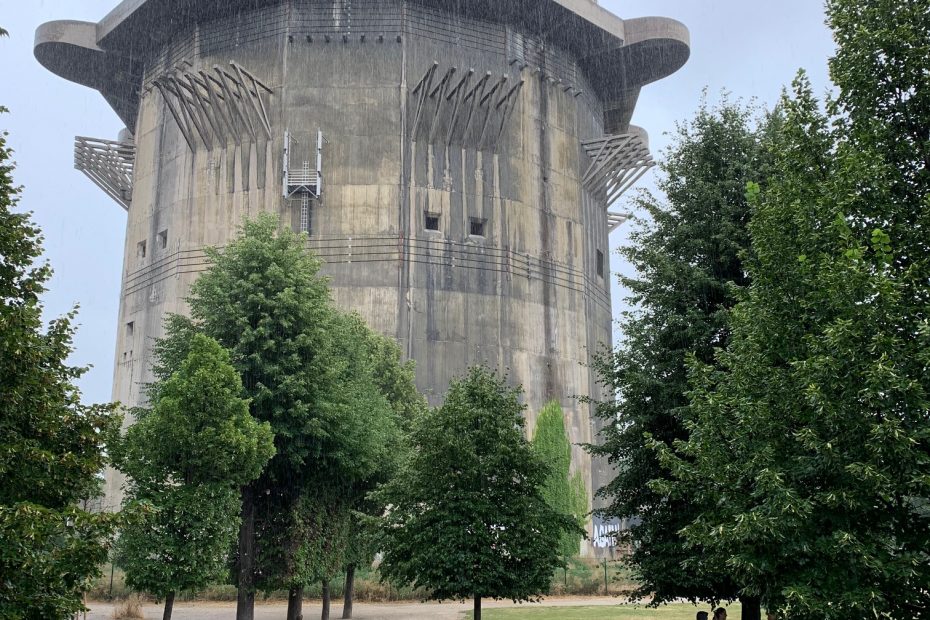
These towers are dotted through the city and are massive bases for anti aircraft artillery. The Vienna flak towers are a legacy of the second world war and now serve mostly as a home for pigeons.
Visiting
The three towers I saw were empty and inaccessible but you could walk around the outside. Two were in Augarten park and one was in central Vienna. The park was about 10 minutes by tram from the centre and you really can’t miss the towers!
My Experience
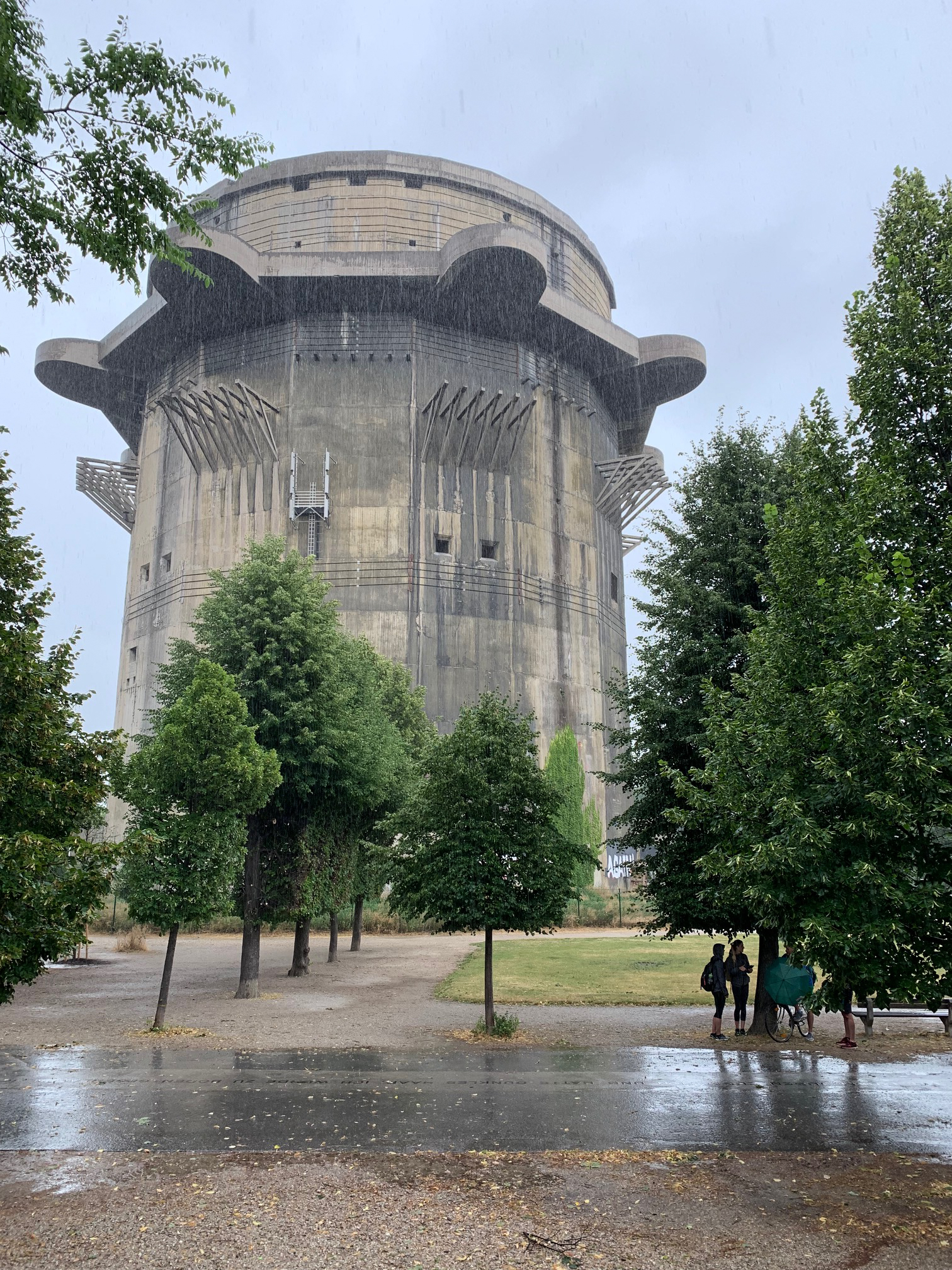
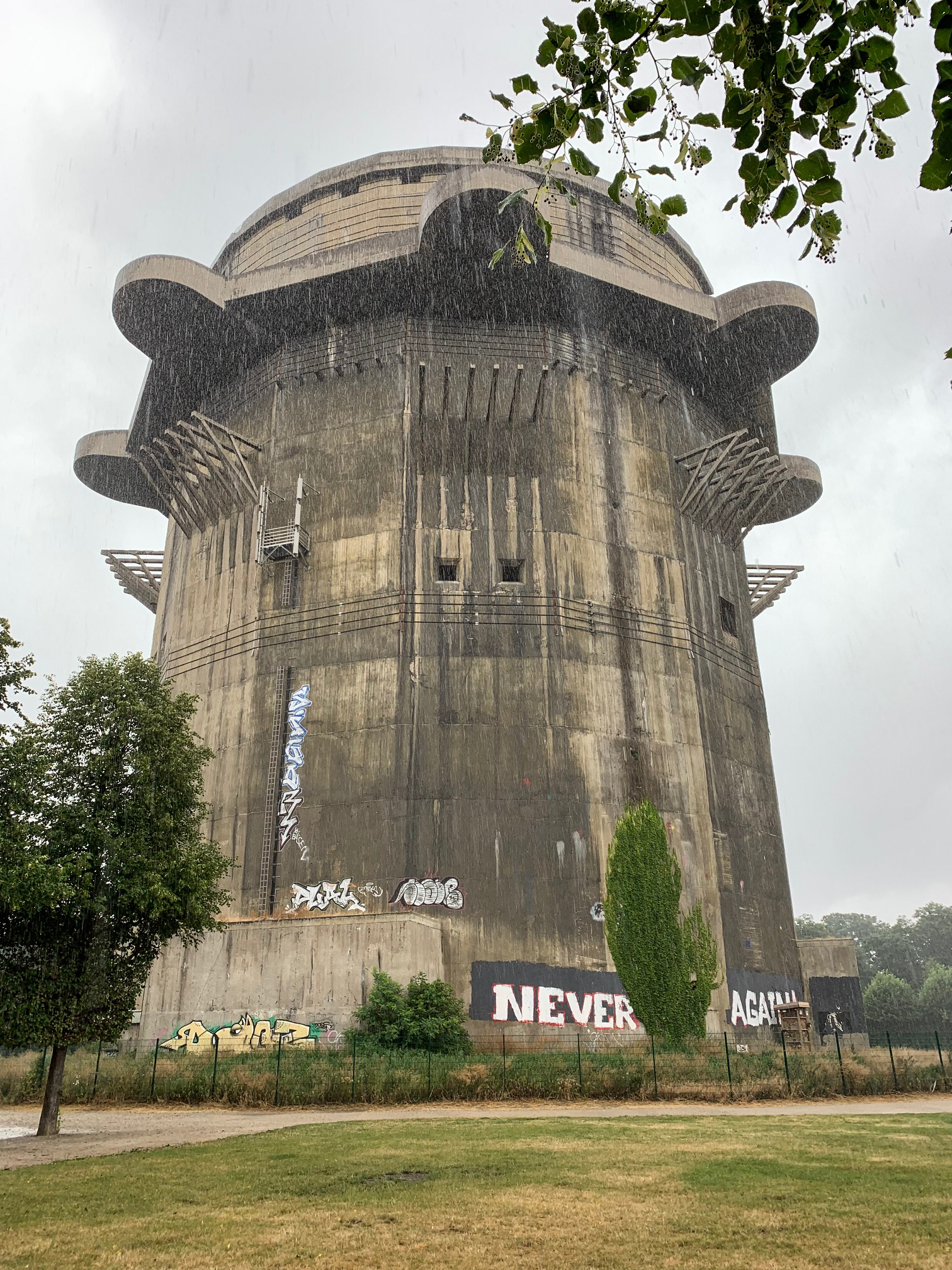
The day I chose to visit the Vienna flak towers it was raining. And by raining, I mean a biblical deluge! Being summer I didn’t have a coat with me so the only two photos were taken whilst sheltering under a tree. Not much use I know!
All I can say is that the towers are massive. Being above the contemporary buildings they would have had a clear field of fire and 360 degree visibility. On my list for my next visit is to see the Vienna Aquarium which is inside one of the towers.
Photo Gallery
History
“In 1942 Adolf Hitler decided to build six flak towers to protect the historic city centre of the so-called Gauhauptstadt Vienna from destruction from Allied airstrikes. The existing towers in Berlin and Hamburg served as models for the architect Friedrich Tamms. All the flak towers are grouped in twos, with a Gefechtsturm (combat tower) and a Leitturm (lead tower) forming one pair. These pairs of towers are arranged in a triangle around the heart of Vienna’s historic centre, the Stephansdom. Originally, the Nazis planned to convert the flak towers into gigantic victory monuments to fallen German soldiers. After the war, the towers were to have been clad in white marble. Fortunately, history turned out differently.
The two flak towers in the baroque Augarten gardens were completed just a year before the end of the Second World War. However, with the Allied bombers flying at such high altitudes the towers were rendered almost useless for military reasons. After the defeat of the German Reich in May 1945 the flak towers stood empty for many years. Unlike in Berlin and Hamburg, the Allies did not attempt to destroy these giant grey blocks. One reason might have been Austria’s long-standing claim as a victim of Nazi aggression. As a result, the towers remain as concrete witnesses to the crimes committed by the Nazi dictatorship and as unforgettable reminders and warnings of Austria’s culpability. But, until now, there has never been an active historical reappraisal.
After more than 70 years, the concrete towers are now an essential and integral part of the city of Vienna and its inhabitants. Today, the overall appearance of the Augarten park is defined by the tension between its tranquil idyll and acts of violence and destruction. A huge graffiti in the plinth area with the words ‘Never Again’ now greets visitors to the park.
Both towers in the Augarten park are owned by the Republic of Austria and administered by the Burghauptmannschaft. Although they have been leased by a data company (since 2002), to be renovated and used as huge data centres, they remain empty and closed to this day. A previous plan proposed the Gefechtsturm to be repurposed as a museum for contemporary history (between 1986 and 1999).
The Augarten Gefechtsturm is a hexadecagon 43 meters in diameter. It is 55 meters high, has a basement and 13 storeys plus an added level for cannons. Most of the outer walls are 2.5 meters thick and the uppermost ceiling is between 3.5 meters and 4 meters thick. The flak tower consists of more than 45,000 cubic metres of reinforced concrete. Like every flak tower, this one also has an integrated natural climate system, which has remained almost intact. The entire technical infrastructure (electricity, water, gas, lift) has either been demolished or not been preserved. Following a grenade explosion caused by children playing in 1946 the Gefechtsturm is badly damaged both on the inside and the outside, particularly the upper storeys. As part of restructuring measures in 2007 two of the platforms known as Schwalbennester (swallow’s nests), which originally served as gun emplacements, were removed as they were at risk of collapsing.”
References
The history of the Augarten towers above is copied from this site.
There is plenty of information on the Vienna Flak Towers here
This site has historical information and also an excellent map of the towers’ locations