
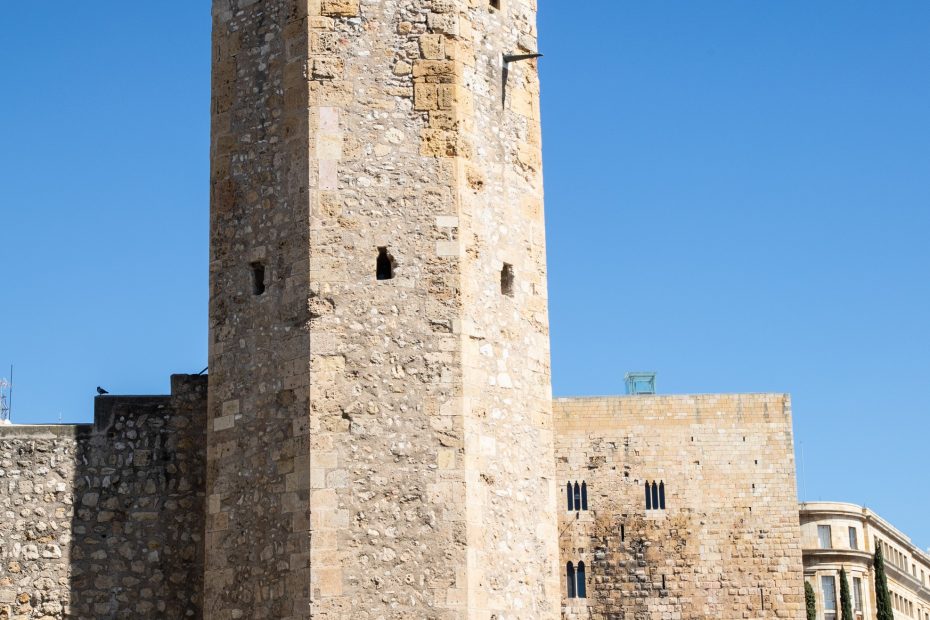
Let’s be honest, although Tarragona may have had Roman walls, what there is of the defences now is a heavily modified medieval version. There are some impressive sights but don’t expect classical Roman fortifications.
Visiting
Tarragona is a decent sized town and has plenty of parking. The main sites are well signposted and we found it to be a very clean and quiet place to visit. There are obviously plenty of cafes and restaurants to. Do not visit on a Monday as everything is closed!
My Experience
We visited as part of our week exploring Catalonia, detailed here.
My notes from the visit were:
“First stop was the Roman aquaduct now called Pont del Diable – this was a bit of a scramble to get to but was a damned impressive piece of 2000 year old engineering. It was difficult to appreciate it properly as it was now in a pine forest and my directive to cut all the bloody trees down obviously hadn’t reached this area.
We then headed into Tarragona and eventually parked and headed off to explore. First stop was the viewpoint over the beaches and then we headed to the Roman theatre. We found it closed as Monday is the new Sunday. We managed to get some views of it from the path but couldn’t go in.
From there we headed to the Roman Circus (closed), Roman walls (closed) and somewhere else too that was closed. Bit of a theme really. It was lovely walking round the city though. The old city is pretty much car free and has some very pretty buildings, lots of interesting art work and plenty of cafes.
Final stop was the cathedral which was open! We spent a lot longer here than expected but it was very pretty which lots of the original medieval wall paintings. The cloisters were great, some lovely eclectic carvings (Parade of the Rats anyone) and a very peaceful garden with turtles sunning themselves in the various pools.”
Tarragona Roman walls have three of the original towers still remaining. These are named Arzobispo, Cabiscol and Minerva. Minerva is the most authentically Roman with the original dressed stonework but also the least well preserved.
Photo Gallery


History
In the 2nd century B.C., a great wall was built around Tarraco, delimiting the municipal boundaries. The wall originally ran some 3,500 metres. Today, approximately 1,100 metres remain, bordering present-day Tarragona’s Old Quarter. The walls are the oldest Roman construction still conserved outside Italy.
Between the 16th and 18th centuries, they were reinforced with bulwarks, a curtain wall and exterior fortifications in order to adapt the Tarragona defences to new forms of artillery. The Passeig Arqueològic, or Archaeological Promenade, winds between the ancient Roman and modern curtain walls and is dotted with shaded gardens, romantic poetry and historical explanations.
Special attention should be paid to the Archbishop’s Tower, which underwent considerable alterations in the Middle Ages, and the Minerva Tower, which is the site of the oldest Roman sculpture and inscription in the Iberian Peninsula.
References
The history above is copied from here.
The town website has an excellent route to explore the Roman history of the city here.