
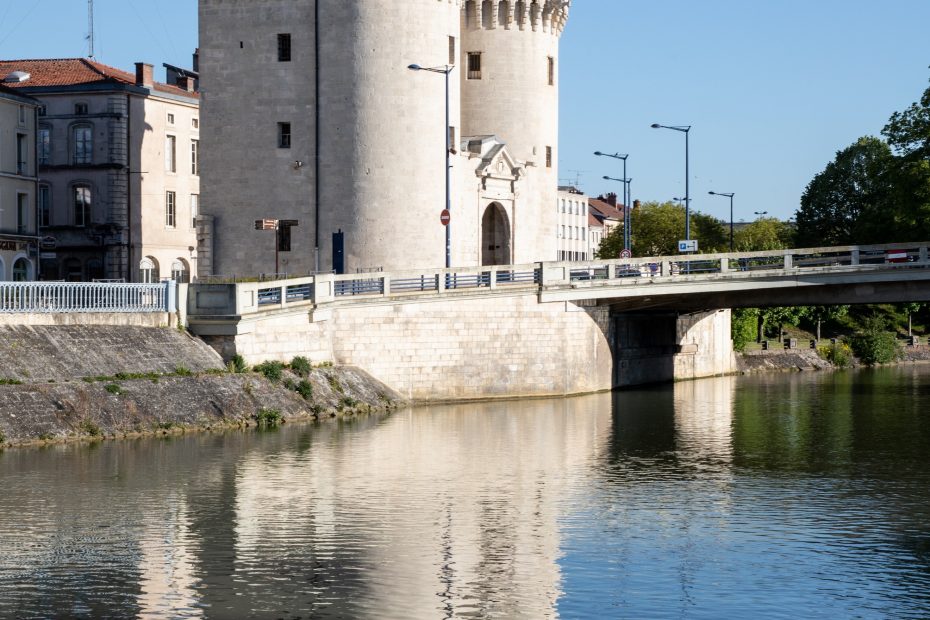
Verdun is the famous (infamous) fortress city of north eastern France that suffered through a year long siege in 1916. This was one of the bloodiest battles of the First World War and the city is now home to a victory memorial. The sites surrounding Verdun are now a historic park awaiting UNESCO listing. Porte Chaussée, Verdun is a fourteenth century gatehouse on the riverbank.
Visiting
The sites are well signposted and there is plenty of parking at each one. There are also information boards giving a brief history of that area. You could easily spend a couple of days exploring all that this area has to offer for WW1 enthusiasts.
My Experience
We visited Verdun as part of our Battle of the Bulge tour and my notes are:
“We then headed into the town of Verdun for our second luxury hotel and it didn’t disappoint. The hotel was a huge 18th century building on the riverbank and we had lovely views over the river and town. We dumped our stuff and then ate at a nice little Turkish place on the riverbank. Another very clean, very pretty and very empty town.
I woke early again and after a quick shower, headed out into the town. I seemed to have the place almost to myself and wandered to the city gatehouse and then up to the victory monument and cathedral, barely seeing another soul. It was an incredibly pretty place, helped by the weather and lack of people. I met Mum and Steve for the by now obligatory pan au chocolate breakfast before letting them wander, meeting Deb for coffee and then heading back to the hotel.
Next stop was our final two sites of Verdun – Trench of the Bayonets (a memorial to a group of French soldiers buried by shellfire with just their bayonets showing above ground) and the Verdun War Memorial. This is actually a museum that gives a general history of WW1 plus a detailed history of the Verdun campaign. They also had a cafe there!
We could have easily spent a few days in Verdun as there was just so much to see but it was a case of being fair on Mum and Deb and also overload, the forts were pretty similar and one line of trenches looks much like another. It was interesting to see just how well cared for it was and how much pride the French had in the defence of the city and the memorials.”
My pages on Fort de Vaux and Fort Douaumont give more detail on the individual locations.
Porte Chaussée, Verdun, on the riverfront is described here as:
“This fortified gatehouse served as the official entry to the city ever since its construction in the 14th Century, as part of the Grand Rampart which surrounded Verdun in the Middle Ages. The gatehouse was offered to the city by Wautrec, a rich citizen who was an alderman. It symbolised the new status of Verdun which was made an “imperial free city” in 1374. By this the city was obliged to maintain its own ramparts and to look to its own defence in the case of an attack.See also :The defensive features of a medieval rampart, the portcullis, arrow-slits and the drawbridge mechanism, the decorative and useful features of a medieval building such as the gargoyles.”
Photo Gallery


History
Wikipedia describes the gatehouse here:
“Porte Chaussée,Verdun, was built in 1380 thanks to the generosity of Jean Wautrec, a rich cloth-maker and the City’s First Magistrate. It is one of the three monumental gates of the Grand Rempart, which symbolizes the new status of Verdun, which became a free city of the Empire in 1374. The gate takes its name from a route established in the 12th century by a wealthy family of Verdun.
In 1690, during the Vauban fortification works, the ogival door was replaced by a semicircular portal surmounted by a Tuscan pediment . At the same time, the south tower which collapsed following a subsidence of the ground was reconstructed identically with the old stones.
In 1755, the tower was ceded to the State which made it a military prison . The latter was closed in 1860 when military doctors denounced the appalling living conditions of prisoners.
In 1880, the drawbridge was destroyed. Military engineers want to pierce one of the towers to enlarge the passage for vehicles, but the inhabitants oppose it. An access route is then built to bypass the door.”
References
TripAdvisor’s information on the gatehouse is here.